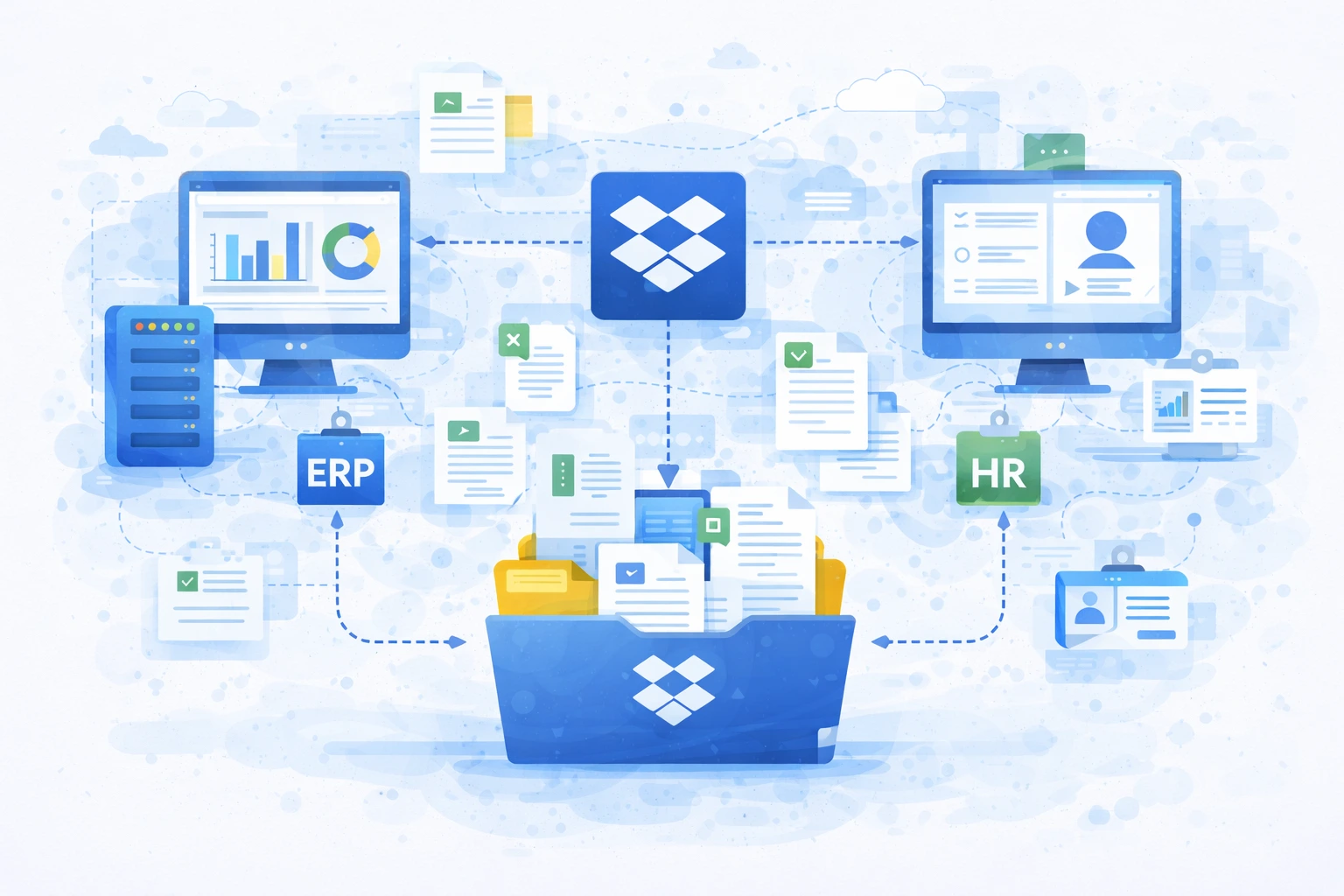
Modern organizations use multiple business systems simultaneously. ERP systems are responsible for financial and operational processes, HR systems manage employee data, and CRM supports customer relationships. Despite the development of these tools, many companies still struggle with managing documents that are created during business processes.
ERP and HR systems work very well with structured data, but they are often not designed to serve as comprehensive document repositories. This is why organizations increasingly adopt an approach in which Dropbox serves as a document layer supporting key company systems.
Why ERP and HR systems do not fully solve the document problem?
ERP and HR systems are primarily designed to handle processes, data, and workflows. Documents usually function as supporting elements, often stored as attachments to records, requests, or transactions.
In practice, this leads to situations where documents are stored in multiple locations, are more difficult to manage, and are harder to search. Expanding document management capabilities within ERP or HR systems is possible, but it often involves high costs and complex configuration.
For this reason, organizations increasingly decide to separate the document layer from process-driven systems.
What is a document layer?
A document layer is an environment responsible for storing, managing, and sharing documents independently of the systems in which process data is created. Its purpose is to provide a consistent workspace for files while maintaining integration with business systems.
Dropbox works very well in this role because it enables centralized document management, access control, file versioning, and team collaboration.
Integrating Dropbox with ERP systems
In ERP environments, documents appear in many processes — from invoices and contracts to project documentation and operational reports. In traditional models, files are stored directly in the ERP system or in local repositories, which often limits collaboration capabilities.
Integrating Dropbox with ERP allows documents related to specific business processes to be stored automatically. The ERP system stores data and operational context, while Dropbox is responsible for document management. This enables users to work with files in an environment designed for collaboration without losing their connection to business processes.
Integrating Dropbox with HR systems
A similar approach works in HR systems, where documents play a key role throughout the entire employee lifecycle. Contracts, annexes, recruitment documents, and onboarding materials require secure storage and easy access.
Dropbox can serve as a central repository for employee documentation integrated with HR systems. Documents generated during HR processes can be automatically stored in folder structures linked to employees or HR workflows. This improves document management and increases transparency across the working environment.
Benefits of separating documents from process systems
Separating the document layer from ERP and HR systems provides several advantages. Most importantly, it enables more flexible document management and easier sharing across teams. Documents are no longer locked within a single system and can be used across multiple processes simultaneously.
An additional advantage is simplified integration between systems. Dropbox can serve as a shared document workspace for multiple applications, reducing the need to duplicate files and lowering the risk of working with outdated document versions.
Security and compliance
In organizations using ERP and HR systems, documents often contain sensitive data, making security a critical element of the solution architecture. Dropbox provides access control mechanisms, data encryption, and user activity monitoring.
This allows documents to be stored and shared in accordance with regulatory requirements and internal organizational security policies.
Technical aspects of integration
Integration between Dropbox and ERP or HR systems can be implemented using APIs, middleware layers, or document workflow automation. Proper design of document flow and connections between files and process data is crucial.
In a well-designed environment, users work with documents in Dropbox, while ERP and HR systems maintain business context and structured data. This model allows organizations to leverage the strengths of both solutions.
When does the document layer approach make the most sense?
This model works particularly well in organizations that use multiple business systems and generate large volumes of documents. It is also beneficial in environments where collaboration between departments and external partners is important.
Dropbox as a document layer helps standardize how files are managed and reduces the chaos caused by documents being scattered across multiple systems.
Summary
Dropbox as a document layer for ERP and HR systems enables organizations to connect business processes with modern document management. Separating documents from process-driven systems increases flexibility, improves collaboration, and strengthens data security.
A well-designed integration architecture allows organizations to fully utilize ERP and HR systems while providing users with a consistent and convenient document workspace.