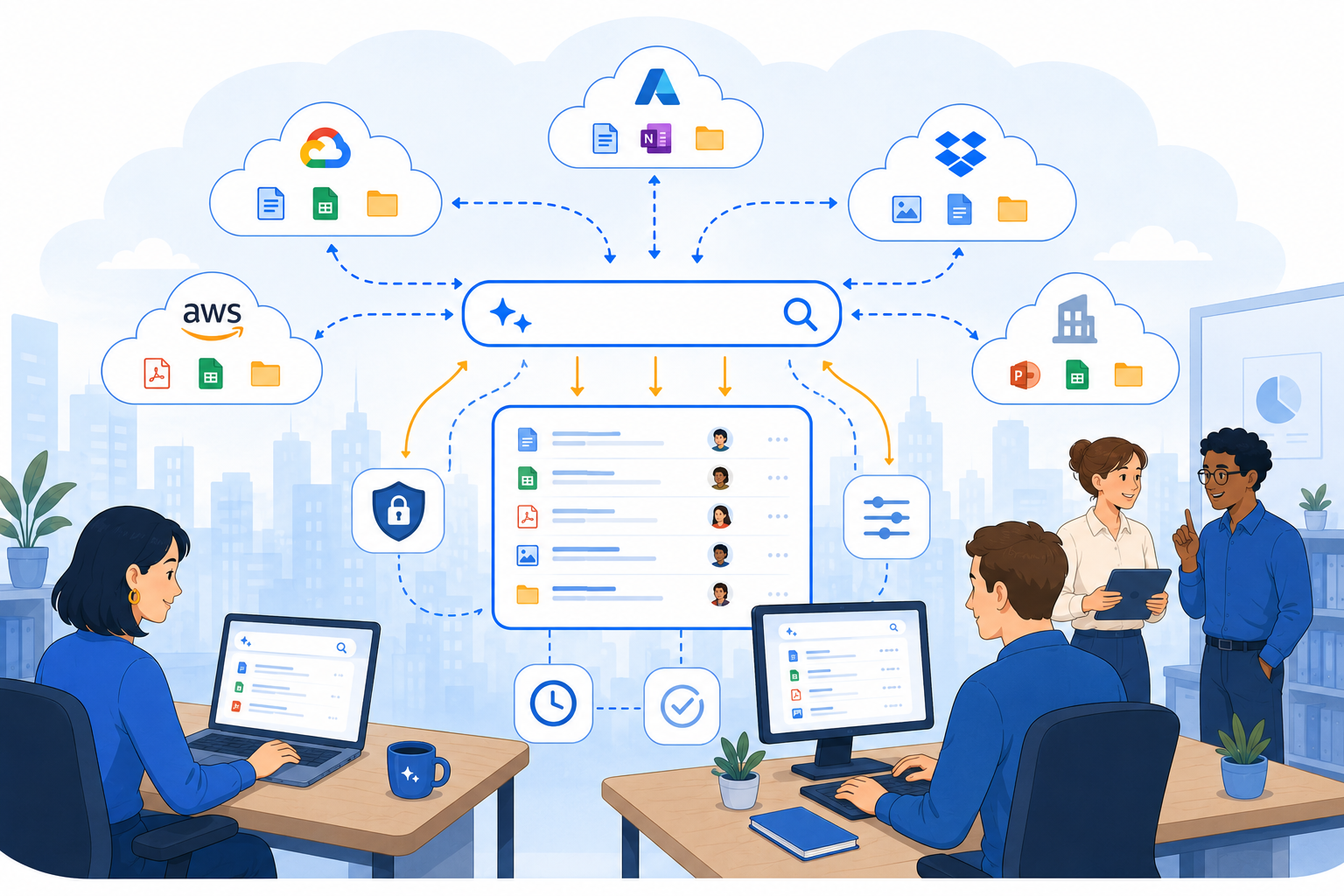
Ask a leadership team which cloud they run on and you’ll often hear a confident “we’re a Microsoft shop” or “we’re all-in on Google.” Look closer and the reality is almost always hybrid: marketing lives in Dropbox, engineering in Google Workspace, operations in Microsoft 365, and critical knowledge buried in Slack, Confluence, and a dozen SaaS tools. The bigger the organization, the more fragmented the picture becomes.
That fragmentation has a cost: people can’t find what they need, and IT can’t see who has access to what. Dropbox Dash is built precisely for this reality—an AI-powered universal search and governance layer that unifies content across Google, Microsoft, Dropbox, and the other tools an enterprise already runs, without forcing everything into a single vendor’s ecosystem.
The Hidden Cost of Multi-Cloud Fragmentation?
When knowledge is scattered across clouds, the friction compounds at enterprise scale:
- Search blind spots. A single query never covers everything—employees check Google Drive, then SharePoint, then Dropbox, then ask a colleague.
- Duplicated and stale content. The same document exists in three places, and no one is sure which is current.
- Permission sprawl. Access rights drift over time, and no one has a unified view of who can see what across clouds.
- Tool-by-tool AI. Native assistants only see their own ecosystem, so insights stop at the boundary of each vendor.
The result is wasted time, compliance exposure, and AI tools that can only reason over a fraction of the company’s knowledge.
How Dropbox Dash Unifies Search Across Every Cloud?
Dash doesn’t replace your existing platforms—it sits on top of them and turns many disconnected sources into one searchable, governed knowledge layer.
1. One Vendor-Neutral Index
Dash indexes content across Google, Microsoft, and Dropbox equally, rather than privileging one vendor’s signals over another. A single search reaches decks, docs, media, and messages wherever they live, so employees stop guessing which app to open. With Connectors, IT can link the company’s content sources in a few clicks and make them instantly searchable.
2. Permission-Aware Retrieval
Unification only works if it’s safe. Dash inherits permissions from each source and checks them at query time, so it can never surface anything a user isn’t already allowed to see. Search becomes universal without becoming a security risk.
3. RAG-Based Answers and Summaries
Beyond finding files, Dash uses retrieval-augmented generation to answer questions, summarize long documents, and pull insights across connected tools—grounded in the company’s actual content rather than free-form generation. Teams can Ask, Summarize, and Write from a knowledge base that finally spans the whole organization.
4. Available Wherever Work Happens
Through Surfaces, Dash is accessible across desktop, web, and mobile, so unified search follows employees wherever they work—not just inside one application.
Governance That Spans Clouds, Not Just One Ecosystem
The hardest part of multi-cloud isn’t search—it’s control. Native assistants tied to a single ecosystem can only see and manage permissions within their own boundary. Content sitting in another cloud becomes a blind spot.
Dash closes that gap with Protect and Control: unified visibility into permissions plus the ability to bulk-update access rights across Google, Microsoft, and Dropbox from one place. When an employee changes roles or a project wraps, IT can correct access at scale instead of fixing each cloud by hand. For large organizations in regulated industries, this centralized governance is the difference between confident scaling and accumulating risk.
Built for Enterprise Security and Compliance
Unifying content across clouds raises the bar on trust, and Dash is built to meet it. The platform carries ISO 27001 certification across Dash Web, Desktop, APIs, Browser Extension, and Mobile, along with SOC 2 Type II, and aligns with GDPR, CCPA, and the Data Privacy Framework. Content is encrypted in transit (TLS 1.2+) and at rest (AES-256 via AWS KMS), and Dash operates on mature, multi-tenant infrastructure with auditing and monitoring built in.
Crucially, Dash’s permission model is inheritance-only: it never elevates or overrides the access controls of the underlying source. Admins can also exclude specific folders, drives, or sites from ingestion to keep the most sensitive content out of scope entirely.
Avoiding Ecosystem Lock-In
Standardizing on a single vendor’s AI can feel simpler—until the organization adds a tool, acquires a company, or onboards a team that lives in a different cloud. A vendor-neutral layer keeps options open. Because Dash treats every major ecosystem equally, enterprises can adopt the best tools for each function without losing a unified way to find and govern their content. That neutrality is what makes Dash durable as the stack evolves.
Why Enterprises Choose Dropbox Dash?
For organizations operating across multiple clouds, Dash delivers four things that matter at scale:
One search across every cloud—Google, Microsoft, Dropbox, and beyond, in a single index.
Permission-aware results—universal discovery that never exposes unauthorized content.
Cross-cloud governance—unified visibility and bulk permission control from one place.
Enterprise-grade trust—ISO 27001, SOC 2 Type II, strong encryption, and vendor neutrality.
One layer. Every cloud. Found and governed.