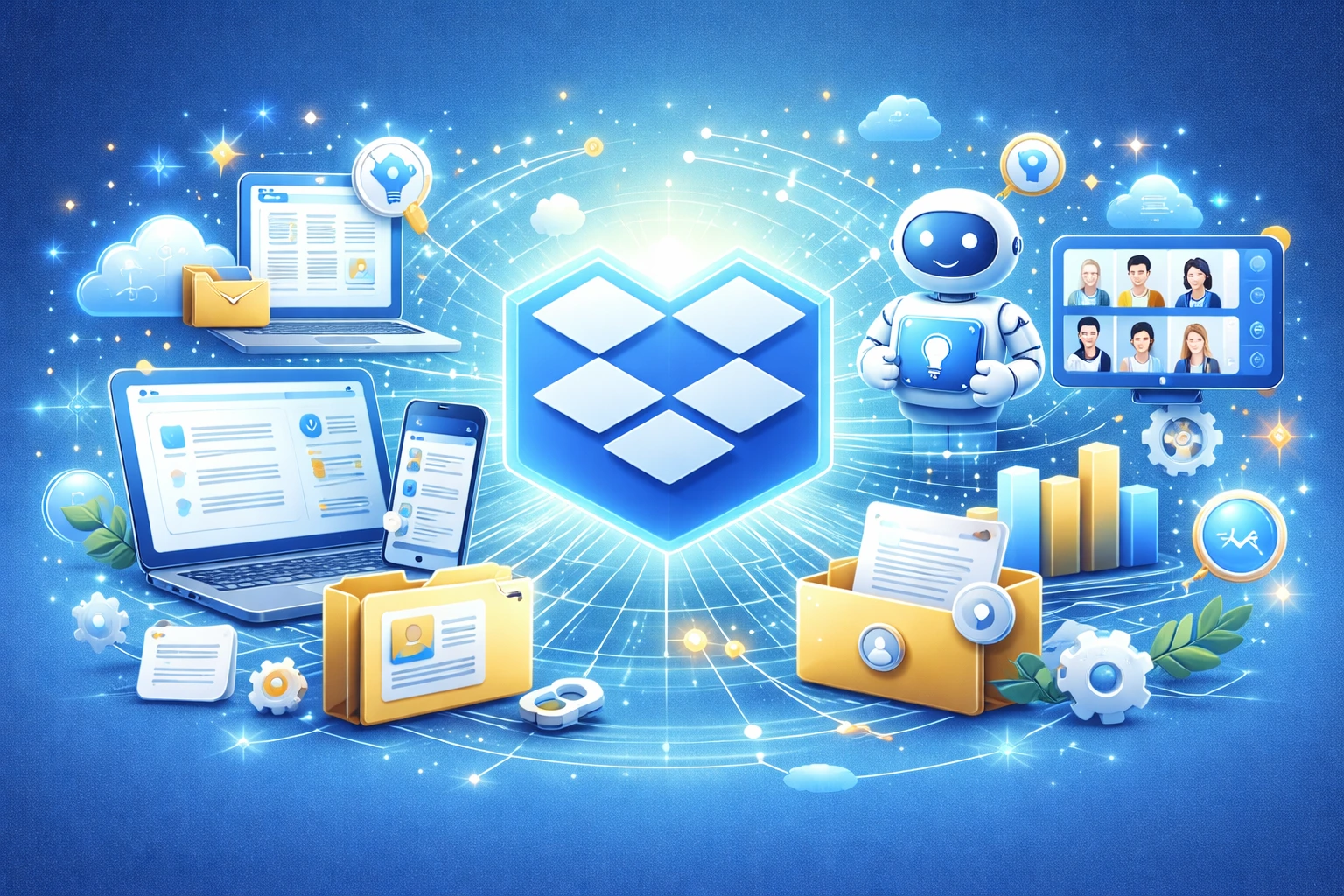
Dropbox started as a simple tool for file synchronization and cloud storage, helping users move away from USB drives and email attachments. Today, it has evolved into an intelligent work platform that supports collaboration, content organization, and productivity for both small teams and large organizations.
In this article, we take a closer look at how Dropbox transformed from a basic cloud storage service into a comprehensive digital workspace, integrating artificial intelligence, smart search, collaboration tools, and modern content workflows.
The early days: simple file synchronization
The history of Dropbox dates back to 2007, when co-founder Drew Houston created a solution to a common problem — keeping files available across multiple devices without manual transfers.
In its early years, Dropbox focused primarily on:
- ease of use,
- fast and reliable file synchronization,
- secure access to data from any device.
This simplicity allowed Dropbox to quickly gain millions of users worldwide, becoming one of the most recognizable cloud storage platforms.
Expanding beyond storage into collaboration
As cloud storage became standard, Dropbox began expanding its functionality toward collaboration and content creation.
A major milestone was the introduction of Dropbox Paper, a collaborative document tool that enabled teams to create, edit, and comment on content in real time. This marked an important shift — Dropbox was no longer just a place to store files, but a space where work actually happened.
This phase laid the foundation for Dropbox’s transition into a broader work platform.
Integrations and productivity-focused features
The next step in Dropbox’s evolution was building a strong ecosystem of integrations. Over time, the platform added support for numerous third-party tools and workflows, enabling users to connect Dropbox with the applications they already used daily.
Today, Dropbox supports:
- secure file sharing across teams,
- version control and file recovery,
- advanced permission management,
- seamless collaboration with external partners.
As a result, Dropbox began serving not only individuals but also entire departments — from marketing and sales to HR, IT, and creative teams.
Artificial intelligence and smart content discovery
One of the most significant directions in Dropbox’s recent development is the integration of artificial intelligence.
A key example is Dropbox Dash, an AI-powered search and productivity tool designed to help users quickly find information across all their connected apps and content sources.
With Dash, Dropbox enables:
- intelligent search based on content meaning, not just file names,
- faster access to knowledge scattered across tools,
- contextual understanding of documents, projects, and tasks.
This represents a major step toward a platform that does not merely store content, but actively helps users understand, organize, and use information.
Security and content governance
As Dropbox evolved into a central work platform, the importance of security and content governance increased significantly.
Dropbox now offers advanced enterprise-grade features, including:
- administrative control panels,
- detailed activity logs,
- access management and permissions,
- data recovery and retention tools.
These capabilities allow organizations to maintain visibility and control over their digital content while supporting flexible and remote work environments.
Dropbox today: a unified work platform
Modern Dropbox is far more than cloud storage. It functions as an intelligent work platform that:
- connects files, tools, and teams,
- supports collaboration across locations and time zones,
- integrates AI to reduce friction in daily workflows,
- helps teams focus on meaningful work rather than searching for information.
For many organizations, Dropbox has become the central layer connecting people, content, and processes.
What’s next for Dropbox?
Dropbox continues to invest heavily in AI-driven experiences and workflow intelligence. The company’s direction suggests a future where work platforms are not just repositories, but active participants in the work process.
By focusing on context, automation, and intelligent discovery, Dropbox aims to help users spend less time managing tools and more time creating value.
Summary
The evolution of Dropbox shows how a product can grow from a simple file synchronization service into an intelligent platform for modern work.
Today, Dropbox brings together cloud storage, collaboration, security, and artificial intelligence into one cohesive environment — helping teams work smarter, faster, and more effectively.
Dropbox is no longer just a cloud. It is becoming the digital workspace where work actually happens.